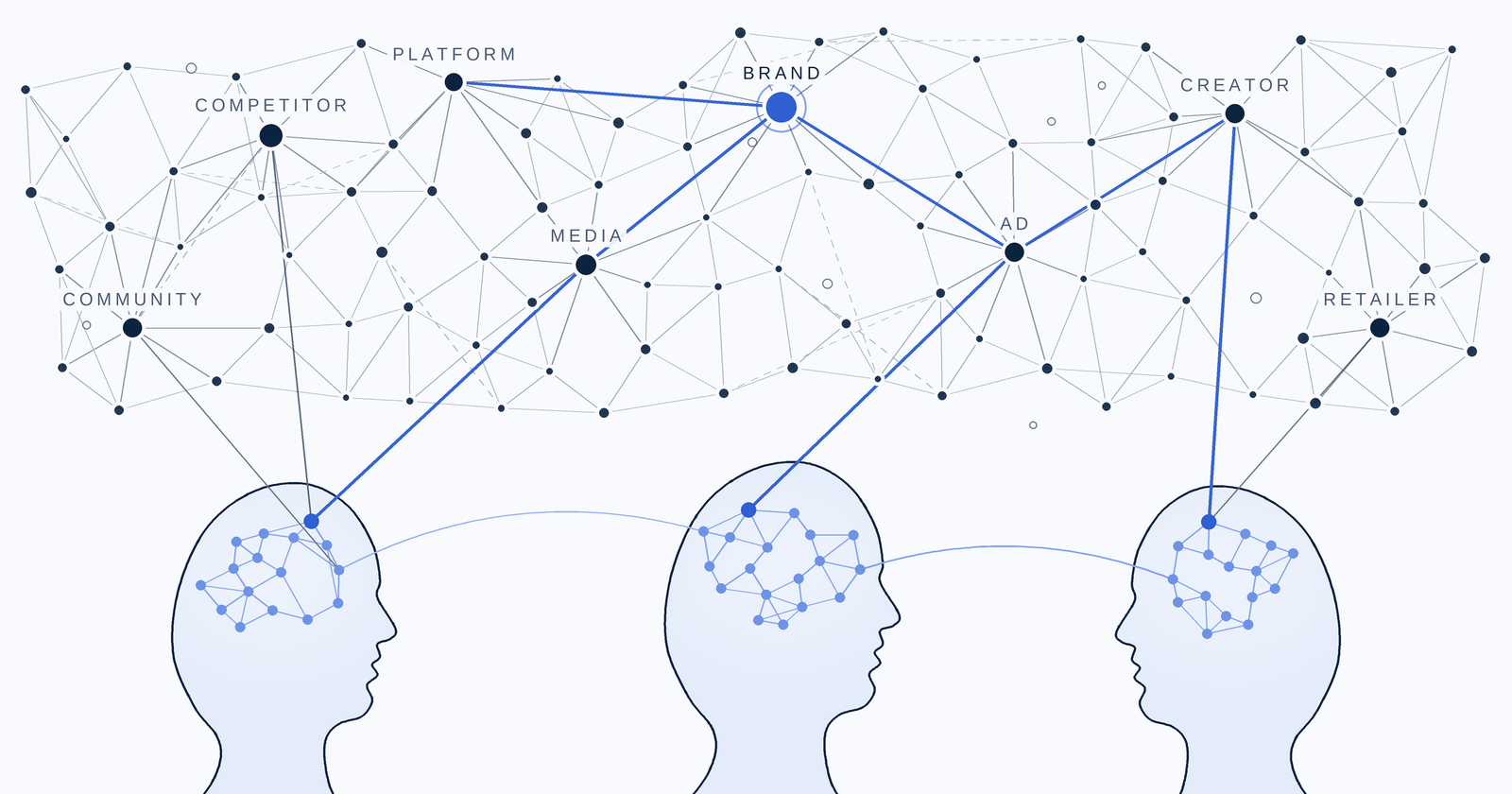
Connection has become one of the defining conditions of modern life. Worldwide, the number of Internet of Things (IoT) devices is projected to more than double, from 19.8 billion in 2025 to more than 40.6 billion by 2034. The precise numbers will continue to change. The direction is much clearer: more things are becoming connected, and the networks connecting them are becoming larger and more pervasive.
And those numbers describe only machines. People are connected to brands, organizations, communities, platforms, algorithms, and increasingly artificial intelligence. Consumers move continually among search engines, social media, stores, friends, influencers, and intelligent systems. We have become extraordinarily good at creating connections.
But that raises a more fundamental question:
Do we understand connection itself?
Counting connections is relatively easy. Understanding what makes them consequential is much harder. A connection may technically be possible but difficult to access. It may exist but have little relevance to the situation. It may be relevant but psychologically weak. A system may contain many connections but still function poorly. Or a seemingly unlikely connection may create new meaning and opportunity because it brings the right things together in the right context.
Being connected, in other words, tells us surprisingly little by itself. That is where Connectism begins.
What changes when connection becomes the focus?
I introduced Connectism in a 2026 article in the International Journal of Advertising as a meta-theoretical paradigm for understanding communication in the connection era. At its core, Connectism conceptualizes communication as a relational, distributed, and emergent process of meaning-making across dynamic connections among human and non-human agents.
The basic shift is simple but consequential. We commonly ask:
How strong is our brand?
How persuasive is our message?
What media should we use?
How capable is this AI system of identifying our customers?
Do our marketing efforts generate results?
All are important questions. But they direct our attention primarily toward individual parts of the marketing system. Connectism adds another question:
How do the connections among them shape influence?
This shifts our attention from the individual elements to the relationships among them – how brands, people, messages, media, technologies, and contexts connect, and how meaning and influence emerge through those connections.
A brand may be well known but lose relevance if it becomes disconnected from the contexts in which consumers now live and make decisions. A strong message can fail because it reaches the wrong person, through the wrong pathway, at the wrong moment. And two ideas that appear unrelated can create new value when someone discovers a meaningful connection between them.
In each case, understanding the individual parts is necessary. But it is not sufficient. Something important is happening between them.
Connection is not one thing
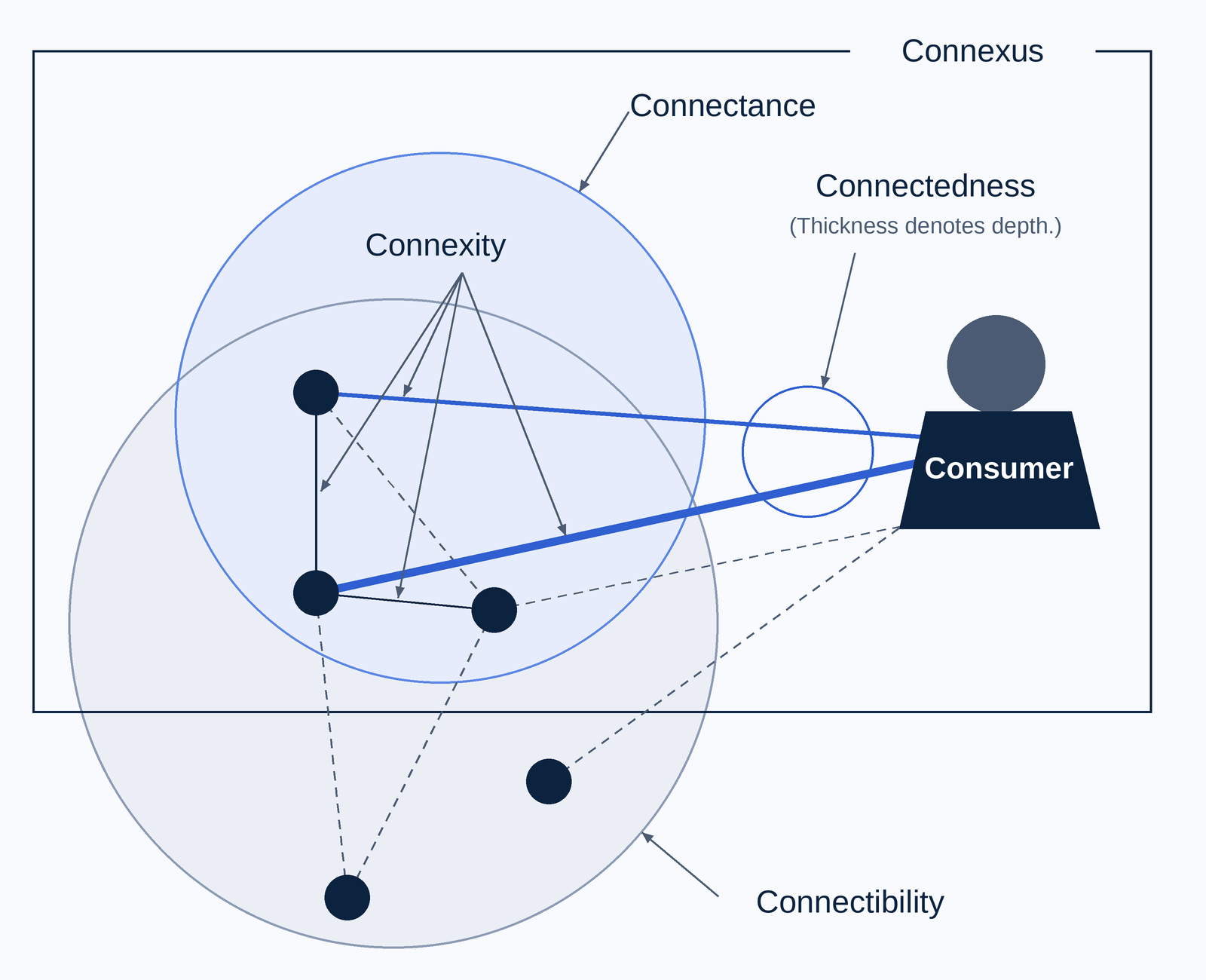
One reason connection deserves closer examination is that it is multidimensional. The Connectism framework identifies five interrelated properties of connection: Connectibility, Connexity, Connectedness, Connectance, and Connexus. Each can be approached through a simple question.
- Connectibility: Can the connection be made? Is there an opportunity for people, information, content, or technology to become connected in the first place – and does that opportunity feel accessible?
- Connexity: Is it the right connection in the right context? Is the connection a meaningful link – relevant, appropriate, and suited to the situation?
- Connectedness: How deeply does the connection resonate? What emotional, cognitive, and motivational depth does the relationship carry – and does it move people to act, share, or advocate?
- Connectance: How much of the possible network is connected – and how saturated does it feel? How densely are relevant connections realized relative to what is possible, and how saturated does the result feel to the people inside it?
- Connexus: How well do the connections work together? How effectively does the connected system operate as an integrated whole, turning potential into realized influence?
These are not five steps in a conventional funnel. They build on one another, and they also feed back into one another: what happens in one part of the system can change the conditions for future connections elsewhere in it. Relevant connections can deepen relationships. Deeper relationships can increase receptivity to future encounters. Denser networks can create additional opportunities for connection.
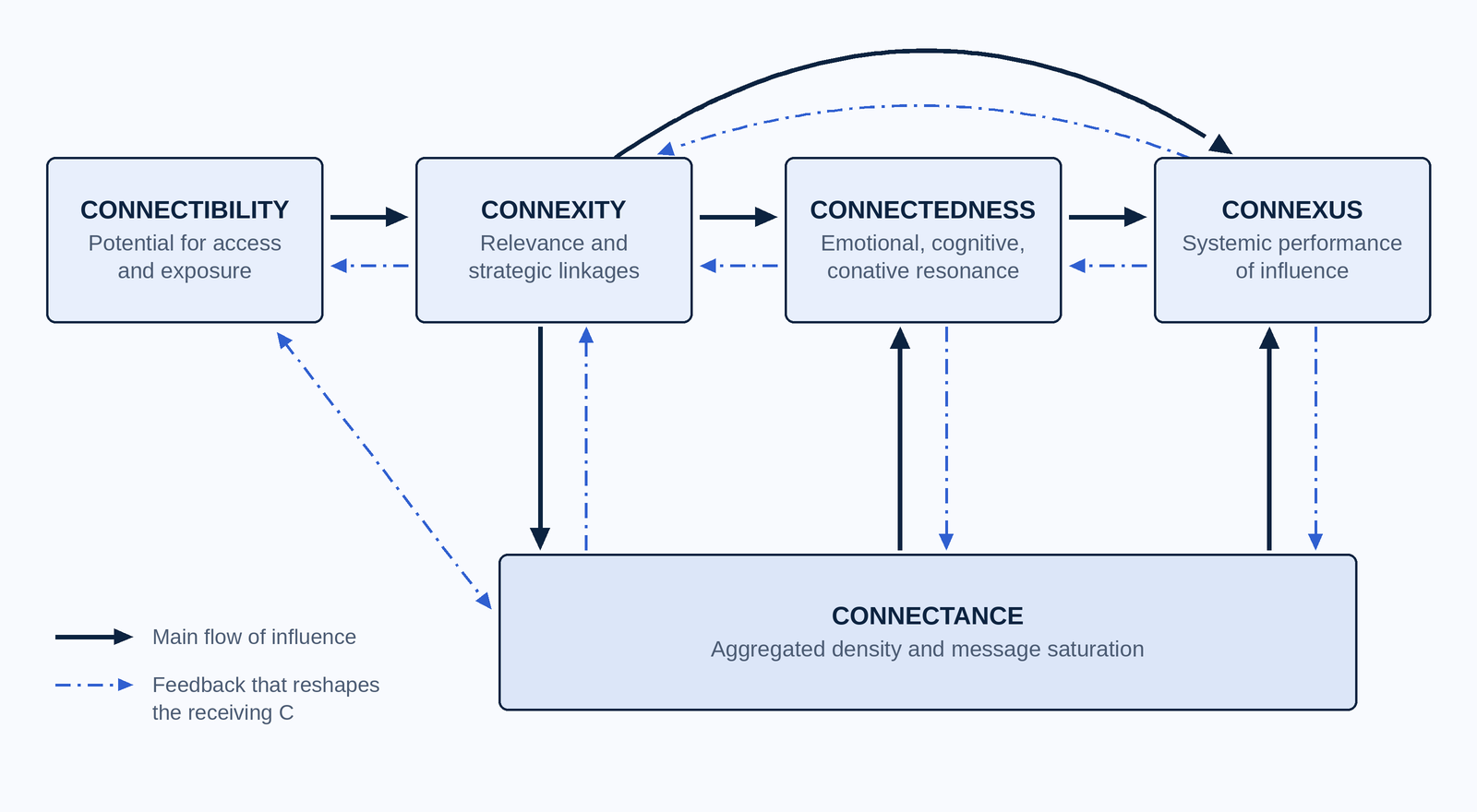
This distinction matters because two situations that appear to have the same “connection problem” may actually involve very different problems. The diagnosis changes depending on what property of connection we examine.
Different problems, viewed through connection
Duolingo offers a useful illustration. In early 2024, Duolingo found that 39% of users on entry-level Android devices waited more than five seconds for the app to open. After more than 200 performance experiments, that figure fell to 8%, while app-open conversion on entry-level devices increased from 91% to 94.7%. Duolingo attributed hundreds of thousands of additional daily active users to these improvements.
Software engineers understandably see this as an app-performance problem. Through Connectism, it can also be understood as a Connectibility problem. The learner, device, application, and educational content all exist, yet friction can prevent a potential connection from becoming an actual interaction.
Duolingo’s famous streaks address another dimension. In June 2026, the company ran a one-time Streak Revival event: learners who had lost a streak of 30 days or more could restore it by completing three lessons. 15.4 million learners revived a streak – nearly 8 million of whom had no active streak when the event began. Duolingo named the event, alongside product and marketing changes, as a driver of 23 percent year-over-year growth in daily active users.
Retention itself is not the definition of Connectedness. But the event shows what a streak had become: not a counter, but a relationship with weight. That weight cuts both ways. Losing a streak can be reason enough to stop returning; restoring it brought millions back. That depth is what Connectism captures as Connectedness – and here, depth also reopened the door to future connection.
Then, in September 2026, Duolingo appeared in an unexpected place: New York Fashion Week. Working with designer Megan O’Cain, the company created a collection featuring phonetic spellings of hard-to-pronounce fashion names. A lime-green bag read “air-mess” for Hermès, and a jacket spelled out Givenchy as “zhee-vahn-shee.”
Why should a language-learning brand have anything to do with Fashion Week?
fashion → designer names → language → pronunciation → Duolingo
The creative idea works not simply because the combination is unexpected, but because the connection has contextual fit. That is primarily a matter of Connexity.
If Duolingo merely attached its name to a popular fashion event, the relationship might attract attention without making much sense. Pronunciation provides the reason the connection belongs there.
As such connections become realized across designers, fashion audiences, social media, press coverage, physical experiences, and other touchpoints, they may also contribute to Connectance by increasing the density of relevant connections surrounding the brand.
Engineering, product design, and marketing look like very different activities. In most companies, they also sit in different budgets, dashboards, and reporting lines. Viewed through connection, however, they can address different dimensions of the same larger communication system. That is the value of changing the lens.
More connection is not necessarily better
It would be tempting to conclude that the solution is simply to create more connections. It is not.
Density is neither good nor bad in itself; it amplifies whatever moves through it. Dense connections can reinforce meaning, increase visibility, and accelerate useful information. But density can also amplify confusion, inconsistency, fatigue, or disruption. Anyone who has felt overwhelmed by notifications already understands this intuitively.
The important issue is therefore not simply how connected something is. We need to understand whether connections can be made, whether they fit their contexts, whether they develop sufficient depth, how densely they are realized, and whether the resulting system operates coherently.
This is why the final C, Connexus, matters. Connexus asks whether the connections ultimately work together, rather than treating each touchpoint or interaction as an isolated success.
When more connection starts to work against us is the subject of a separate essay, More Connection Is Not Always Better.
Looking at what happens between things
The lens is most useful when diagnosing a specific problem. Suppose a brand is struggling. The cause could lie in very different places:
- The advertising itself is weak.
- Consumers rarely encounter the brand in the environments where their decisions now take shape.
- They encounter it frequently, but the message does not fit what they need at that particular moment.
- The encounters are relevant but never develop sufficient emotional or motivational resonance.
- The brand appears everywhere, but its many connections do not form a coherent system.
Those are different problems. Looking primarily at the brand, advertisement, consumer, or platform can obscure those differences. Looking at the connections among them makes the differences easier to see.
The same logic extends beyond advertising. Organizations depend on connections among people, information, expertise, authority, and action. Media systems depend on connections among sources, content, platforms, audiences, and algorithms. Artificial intelligence increasingly operates through connections among people, information, technologies, and contexts. Innovation frequently occurs when previously separate domains become meaningfully linked.
The specific mechanisms differ. The broader question remains:
What can we understand by examining not only the things themselves, but also the connections through which they become consequential?
A world built on connection
We are entering a world in which connectivity itself is becoming almost invisible because it is everywhere. Billions of devices communicate across the Internet of Things. Digital platforms continuously link people and content. Artificial intelligence can retrieve, generate, combine, and act upon information across increasingly complex environments. The capacity to connect is expanding rapidly.
But connection is not merely a technical state. Connections differ in their potential, relevance, depth, density, and integrative performance. Those differences shape whether information moves, whether relationships strengthen, whether meaning emerges, and whether influence ultimately produces consequences.
That is the territory Connectism seeks to understand. Its central proposition is not simply that everything is connected. Increasingly, that is obvious. The more interesting proposition is that what happens in connected environments cannot always be understood by studying the individual parts alone.
Sometimes the explanation lies in what happens between them. And sometimes the opportunity does too.