
River Island did something that seems counterintuitive in a world obsessed with engagement.
It sent fewer emails.
According to a case study published by Bloomreach, River Island’s email platform provider, the British fashion retailer reduced its overall email volume by 22.5 percent in a two-phase A/B test. Revenue per email increased 30.9 percent, orders per email increased 30.7 percent, open rates rose 26 percent, and unsubscribe rates fell 12.8 percent. Most importantly, revenue per customer did not decline. It edged up slightly.
Less communication produced more value from each communication.
That result challenges one of the most persistent assumptions of contemporary marketing: if connection is valuable, more connection must be even more valuable.
More channels. More emails. More notifications. More stores.
But connection does not necessarily work that way.
A system can become more connected and less effective at the same time.
When connection becomes congestion
Digital technologies have made creating connections remarkably easy. A brand can reach the same consumer through email, text, apps, social media, search, retail media, loyalty programs, and increasingly AI agents. Each new connection can make sense on its own.
The problem appears when we look at them together. Another email competes with previous emails for attention. Another notification makes the next one easier to ignore. Another store may take sales from a nearby store carrying the same brand.
The marginal value of a connection therefore depends partly on the connections already surrounding it. I call the condition that can result Connection Congestion.
Connection Congestion occurs when increasing the number or density of connections creates enough redundancy, competition, overload, or interference that additional connections stop adding positive systemic value and may begin to weaken the performance of the system.
A particular connection does not have to fail for congestion to emerge. It can still generate clicks or sales while adding less value than the system gives up elsewhere. That is why counting connections is not enough.
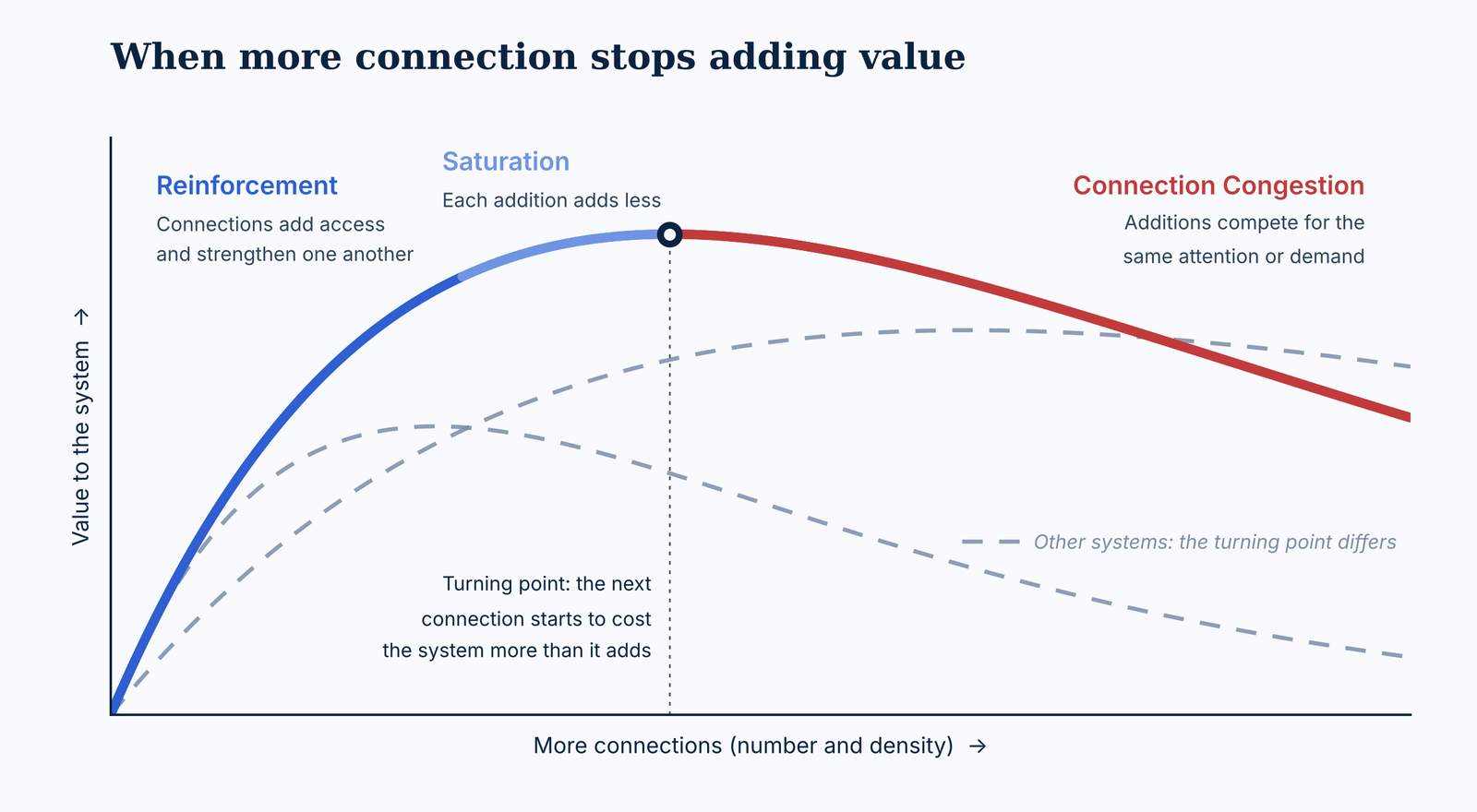
More contact can make each contact worth less
River Island was not trying to rescue a failed email program. It already had a successful one, and its solution was not simply to send fewer emails to everyone. Customers were segmented by their level of engagement, and frequency limits were applied accordingly. Campaigns were also prioritized so that consumers eligible for several campaigns in a given period did not automatically receive every possible message.
The lesson is not that less communication is inherently better. River Island made each connection more selective and more relevant.
Research helps explain why this matters. A meta-analysis of 18 studies involving 24,236 people found that, across persuasive campaigns, greater message fatigue – the sense of having received too many similar messages – was associated with less favorable outcomes. And a meta-analysis of advertising repetition shows that repeated exposure can help at first but does not produce endlessly increasing returns.
The company did not eliminate the connection. It regulated its density.
Subway built more access – until access began competing with itself
For decades, Subway pursued one of the most aggressive expansion strategies in restaurant history. By 2014, it had 27,205 U.S. restaurants.
Yet that year produced a striking combination. Subway added 778 U.S. restaurants while its systemwide sales fell by about $800 million. QSR Magazine observed that the combination lowered average unit volume and suggested the brand might be encountering market saturation.
Adding restaurants did not necessarily mean adding equivalent new demand.
Years later, franchisees described the problem more directly. Restaurant Business reported widespread concerns that there were simply too many locations. In some markets, development agents had encouraged or required new restaurants close to existing ones.
Another Subway still sold sandwiches. But if much of that business came from a Subway a few blocks away, it redistributed existing demand instead of creating new value for the system. Connections had begun competing with other connections inside the same system.
Subway’s footprint has since contracted dramatically. At the end of 2025, it had 18,773 U.S. restaurants, down 3,417 since the beginning of 2021. Restaurant Dive describes oversaturated markets and low average unit volumes as part of the long-running challenge.
Subway’s difficulties had many causes, from products and pricing to franchise economics. But the company itself eventually changed the language of growth. In 2022, it said it was moving from a development-focused organization toward an experience-focused strategy, with “optimizing the brand’s footprint” among its priorities. The question moved from How many locations can we add? toward What should the network of locations actually look like?
Connectance is not Connexus
The original Connectism article distinguishes five properties of connection. Two matter most here: Connectance, the density and saturation of realized connections, and Connexus, the integrative performance of the connected system.
High Connectance is not a problem in itself. Dense networks can increase access, reinforce meaning, and create new opportunities for connection. But greater density does not automatically produce greater integrative performance.
The original article describes Connectance on two levels. Structurally, it is how many of the possible connections are actually realized. Perceptually, it is how saturated that structure feels to the people inside it. River Island ran into a perceptual limit: customer attention. Subway ran into a structural one: local demand. Either way, the limit is not the number of links but what people and markets can absorb.
When additional connections lack relevance, repeat what others already do, or compete for the same attention or demand, density creates congestion rather than synergy. The mistake is not having many connections. It is treating more connection as evidence of a better connection system.
The marginal connection matters
Organizations typically evaluate connections individually. How much revenue did this email generate? How much did this store sell? Those are useful questions. But they miss the systemic effect.
Suppose a new email generates sales but also makes customers less attentive to the next three messages. Suppose a new location is profitable but draws much of its traffic from two existing locations. Suppose a new app notification produces engagement while increasing opt-outs from notifications overall.
The connection succeeded by its own metric.
The system may not have.
River Island could see the difference only because it tested at the level of the customer, not the individual email. Most dashboards measure the connection. Few measure the system around it.
A Connectism perspective therefore adds another question:
What does this connection do to the other connections around it?
Does it create new value or mostly redistribute existing value? Does it strengthen people’s receptivity to future connections or make them more likely to tune out? These questions shift management from connection accumulation toward connection orchestration.
The next connection
For much of the digital era, organizations have asked: How can we create more connections with customers? That question made sense when connection itself was scarce.
It makes less sense when connection can be created almost instantly and at enormous scale, and AI will push the cost of producing messages, recommendations, and other brand touchpoints even lower. The scarce resource is increasingly something else: attention, relevance, coherence, trust, and the system’s ability to integrate everything it already contains.
So perhaps leaders should ask:
Will the next connection make the system better – or simply make it more connected?
There is no universal number of emails, stores, or touchpoints at which congestion begins. Nor is Connection Congestion an argument for simplification at all costs.
Sometimes the system needs another connection.
Sometimes an existing connection needs to become stronger.
Sometimes several connections need to work together differently.
And sometimes the best way to improve a connection system is not to add another connection at all.
The connection era gives organizations extraordinary power to connect.
Its next challenge may be learning when enough connection is enough.