Connectibility
Can the connection be made?
Definition
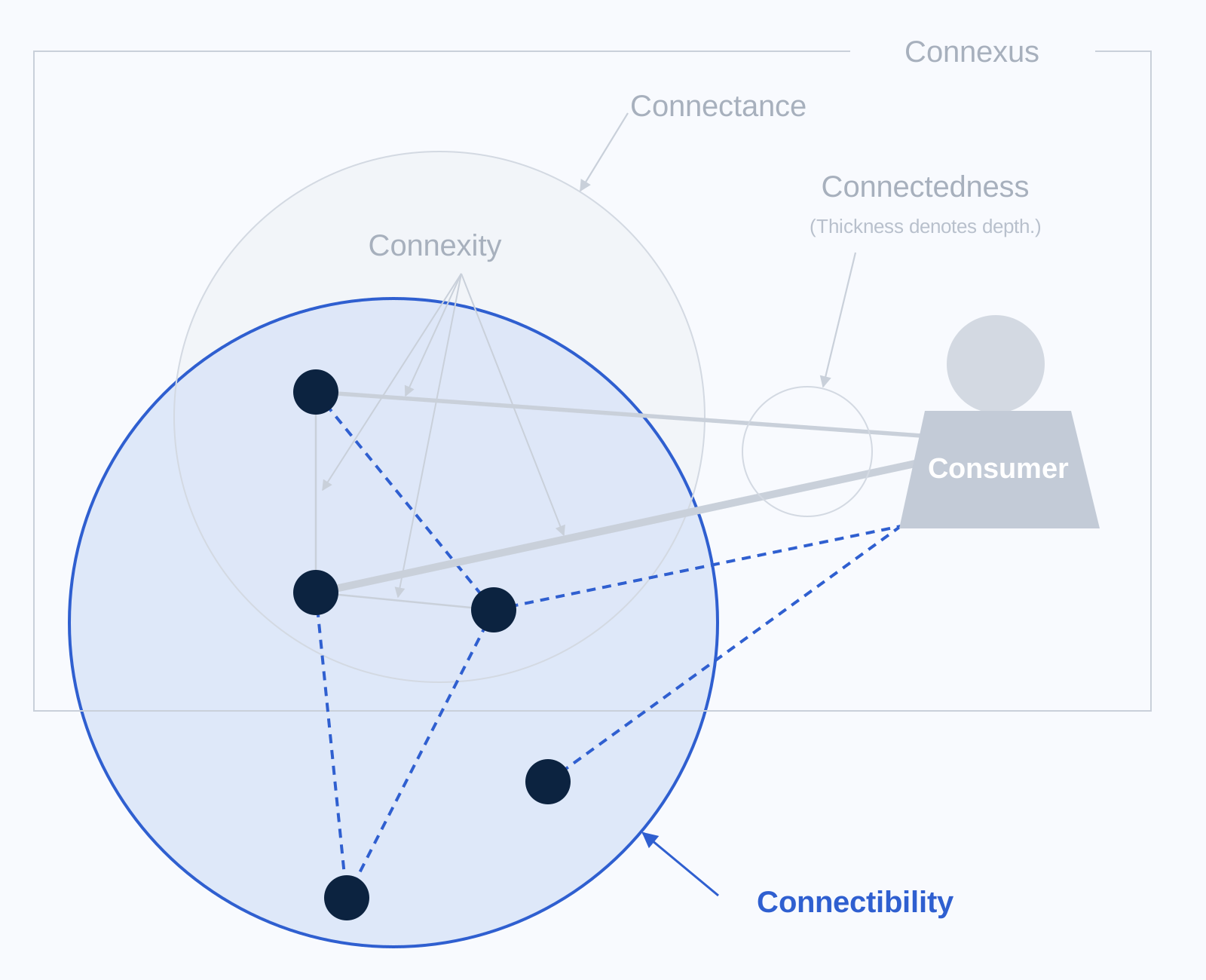
"Potential for forming connections, representing unrealized but possible links." (Kim 2026)
In plain terms
Before anything else can happen, a connection has to be possible. Connectibility is the potential for people, content, and technologies to connect – the access points, visibility, and pathways that make connection possible. It also has a felt side: whether a connection seems open and reachable from the other person's point of view. In network terms, it resembles bandwidth – capacity for connection, even before any tie exists.
Why it matters
When connectibility is low – because of friction, avoidance, or unequal access – nothing that follows can happen. Today, connectibility depends not only on media access but on the breadth of everyday touchpoints, from phones and wearables to smart-home devices and physical spaces.
Questions to ask
- Where do the people we want to reach actually make decisions – and can they find us there?
- What friction stands between a potential connection and an actual one?
- Does connecting with us feel easy and inviting, or effortful?
How it connects
Connectibility sets the range of what is possible. Connexity decides which of those possibilities are the right ones. And dense, active networks can, in turn, open up new opportunities for connection.
See it in practice
Understanding the World Through Connection – Duolingo's app-speed experiments
Source
Kim (2026), International Journal of Advertising. See the Research Foundation.