On September 21, Nike left the S&P 100 after nearly 18 years, in a quarterly rebalance S&P Dow Jones Indices announced on September 4. Ten days later, its first-quarter results showed revenue down 4 percent, alongside a forecast of a high-single-digit decline for the full fiscal year. By Fortune’s count, the company had already lost more than three-quarters of its market value since its 2021 peak.
How does a brand as recognizable as Nike reach this point while almost everyone still knows it?
Nike’s recent difficulties are complex, and no single explanation can capture the full picture. But the public evidence points to a useful lesson: a brand can remain highly recognizable even as important connections around products, retailers, consumers, communities, and culture become less mutually reinforcing.
Nike’s problem is clearly not a simple loss of awareness. Tracksuit’s U.S. tracking showed Nike awareness at 94 percent in 2024, the highest among the competitors it tracked. Yet between April and September of that year, consideration fell from 79 to 73 percent and preference from 39 to 33 percent. Usage also declined. That divergence was visible two years before Nike left the S&P 100.
A brand can still look strong while its connections weaken.
A strong brand is a system of connections
Brands are usually discussed as assets. They have equity, reputation, identity, positioning, and financial value. Those concepts are useful, but they can also make a brand appear more self-contained than it really is.
Connectism begins from a different premise: meaning and influence arise through relationships rather than from isolated messages, people, or organizations. Communication unfolds through dynamic connections among human and non-human agents, and influence emerges from how those connections interact within a larger system. The original Connectism article develops this perspective in detail.
Think about Nike at its strongest. Its power never resided only in the Swoosh or in what consumers remembered about it. Nike was connected to innovative products, elite athletes, sporting events, retailers, sneaker stores, communities, advertising, media, popular culture, technologies, and markets.
Those connections reinforced one another. An athlete gave a shoe meaning. Advertising amplified the athlete and the product. Retailers created discovery. Sneaker communities interpreted releases and gave them cultural value. Consumers wore the products, talked about them, and made them visible to other consumers.
What we eventually call brand strength is therefore, in part, the visible result of a much larger system of connections working together. That also means a brand can continue to look powerful after parts of the system that produced that power have begun to weaken.
Recognition outlasts connection
Connection does not necessarily deteriorate everywhere at the same speed. Recognition, symbols, memories, familiarity, and heritage accumulate over many years and can remain durable. Other properties of connection can change much faster.
Connectism distinguishes these properties through the 5Cs: Connectibility is the potential for forming connections; Connexity concerns their relevance and contextual fit; Connectedness their experiential and emotional depth; Connectance the density and saturation of realized connections; and Connexus the integrative performance of the connected system.
A brand can therefore remain highly recognizable while becoming less relevant, less resonant, or less coherent as a system. Nike’s 2024 numbers show exactly that split: awareness at 94 percent, while consideration and preference were falling.
Yesterday’s connections can continue to produce recognition even when today’s connections are becoming weaker.
The danger of optimizing one connection
Nike’s direct-to-consumer strategy reveals another important problem. There was a clear logic behind strengthening the direct Nike-consumer connection: greater control over presentation and customer experience, more direct consumer data, stronger digital interaction, and less dependence on intermediaries.
Looked at one relationship at a time, that strategy made considerable sense. But consumers do not experience brands through one relationship at a time.
As Nike shifted more activity toward its own channels, relationships elsewhere in the system also changed. Sneaker Freaker described the shift from a sneaker-culture perspective, including product fatigue, the movement of sought-after products toward Nike’s own digital channels, and the diminished role of some physical sneaker stores in discovery and community. Tracksuit similarly pointed to reduced retail partnerships and tastemaker collaborations as part of a broader loss of cultural momentum.
Philipp Dubach’s analysis reaches a related systems conclusion through the economics of complementary assets: decisions that appear rational individually can collectively weaken a larger system when the assets and relationships depend on one another.
Nike’s current turnaround makes this point especially visible. Its fiscal 2026 filing describes reinvesting in wholesale, improving presentation in physical retail, reducing discounting on its own digital channels, and increasing brand and sports marketing. Nike Brand wholesale revenue rose 6 percent to $27.5 billion in fiscal 2026, while Nike Direct fell 6 percent, including a 12 percent drop in Nike Brand Digital.
But the first quarter of fiscal 2027 shows why reopening a channel is not the same as restoring a connection. Wholesale revenue slipped 1 percent, led by Greater China, and Nike told investors it was working with retail partners to clear aged footwear where sell-through had fallen short of expectations.
Reopening wholesale put Nike products back in front of more consumers. But unsold shoes on partners’ shelves suggest that access alone did not make those encounters relevant or compelling enough to turn into purchases. In Connectism terms, Connectibility returned faster than Connexity and Connectedness.
Where Nike has rebuilt a whole system around a community, the early pattern looks different. Under what CEO Elliott Hill calls the Sport Offense – organizing product, marketing, and marketplace around specific sports and the communities that play them – running and North American basketball grew by double digits, and World Cup national-team kit sales reached twice their 2022 level. Sportswear, Jordan Brand, and Greater China continued to decline.
None of this is an argument for funding every connection equally. Focus is necessary, and it usually means reallocation, not more spending. The real distinction is between lightening a connection and breaking it. Retail partners were not only a sales channel; they did work for the rest of the system – discovery, community, cultural validation. A connection can receive less investment and still do that work. The system weakens when a connection stops doing its work and nothing else takes it over. The Sport Offense is itself a reallocation: it concentrates resources on clusters where athletes, product, and community reinforce one another.
A healthy connection system allows one connection to create conditions that support other connections.
The same choices face any sportswear brand.
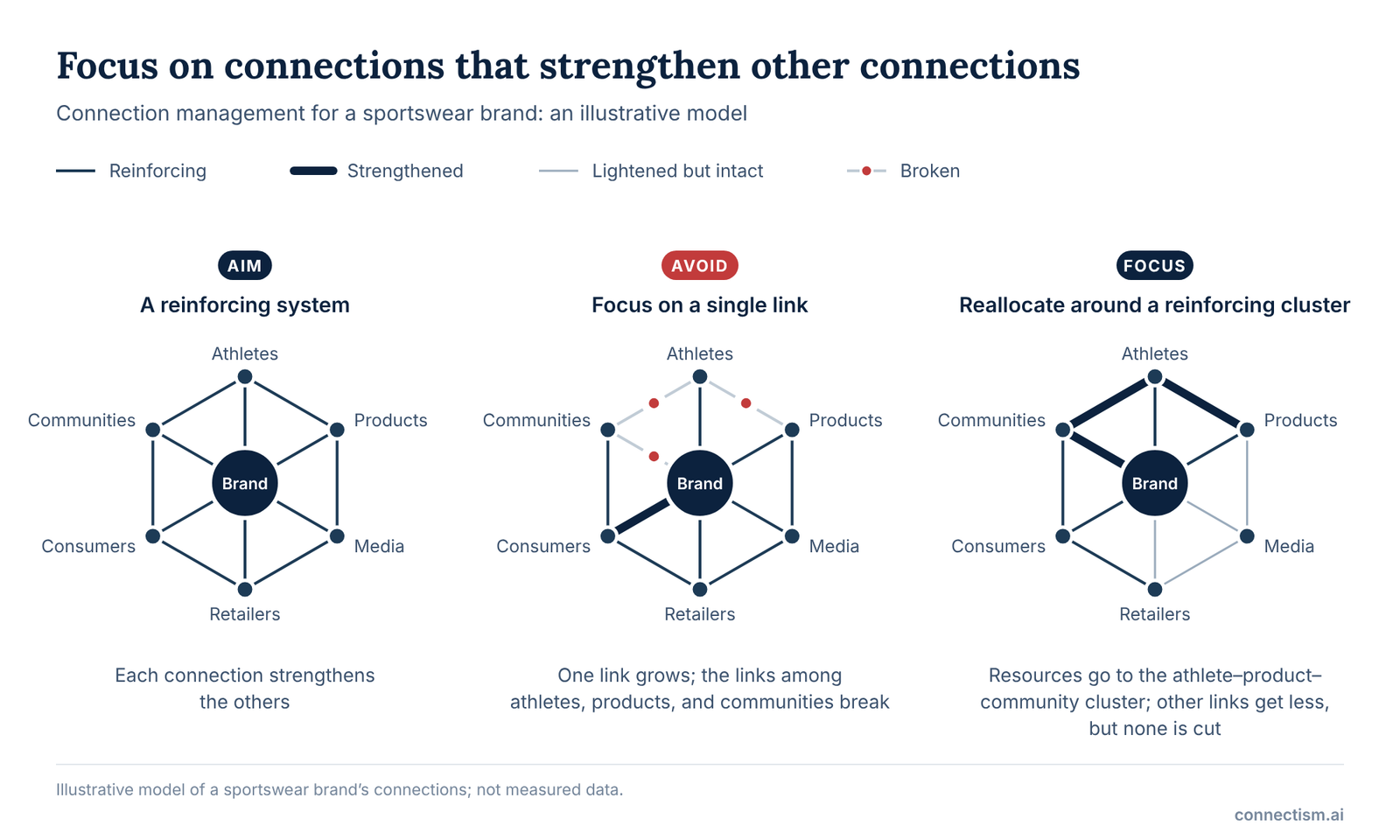
Nike is not simply moving from digital back to physical. It appears to be trying to rebalance a broader marketplace of connections. When Nike presents long-term targets at its Investor Day on November 16–17, the question worth asking is not which channel should dominate, but how the connections should work together.
Look for divergence before decline becomes obvious
The first warning sign may not be that every brand metric begins falling at once. It may be that relationships that once reinforced one another begin moving in different directions.
Awareness stays high while consideration falls. Digital access improves while physical discovery weakens. A direct channel grows while partner relationships deteriorate. Reach remains enormous while cultural relevance declines. Customer interactions remain plentiful while their experiential quality becomes shallower.
None of these patterns alone proves that a brand is in decline. But divergence matters because a strong aggregate number can conceal weakening relationships elsewhere in the system.
Divergence can run in both directions. In 2024, Nike’s awareness looked strong while important connections were weakening. In 2026, connections in running and basketball are beginning to strengthen even as the company’s broader performance remains weak. In both directions, changes in the connection system can show up before headline measures of brand or business performance fully reflect them.
This is especially important because connections are recursive. Relevant encounters can deepen emotional connection. Deeper connection can increase receptivity to future encounters. Dense, well-aligned networks can generate new opportunities for connection. When the system works well, connection can help produce more connection. The reverse can happen too.
That is why leaders should not wait for awareness to collapse before examining the system underneath it.
Ask a different question
Nike’s removal from the S&P 100 does not prove a Connectism explanation; S&P describes it as a routine quarterly rebalance, and the decline involves many factors.
But the announcement is a powerful trigger for a broader question. Instead of asking only:
How strong is our brand?
leaders should also ask:
How healthy is the system of connections that makes our brand strong?
And perhaps one more question matters just as much:
When we shift resources, which connections can we lighten – and which ones are doing work that nothing else will do?
Strong brands must keep reconnecting
Iconic brands accumulate enormous advantages. Their names become familiar. Their symbols acquire meaning. Their histories become cultural memory. But accumulated recognition should not be confused with permanently healthy connection.
Consumers change. Technologies change. Retail systems change. Communities change. Competitors form new relationships. Cultural contexts move on. A strong brand therefore cannot rely only on the connections that made it strong in the past. It has to keep reconnecting.
Nike shows why that distinction matters. The Swoosh did not suddenly become unfamiliar; the relationships around it became less mutually reinforcing. Its early turnaround points to the alternative: concentrating on connections that strengthen other connections.
A brand can still look strong while its connections weaken. In the connection era, brand strength is not simply something a company has accumulated. It is something its system of connections must keep producing.