Connectance
How much of the possible network is connected – and how saturated does it feel?
Definition
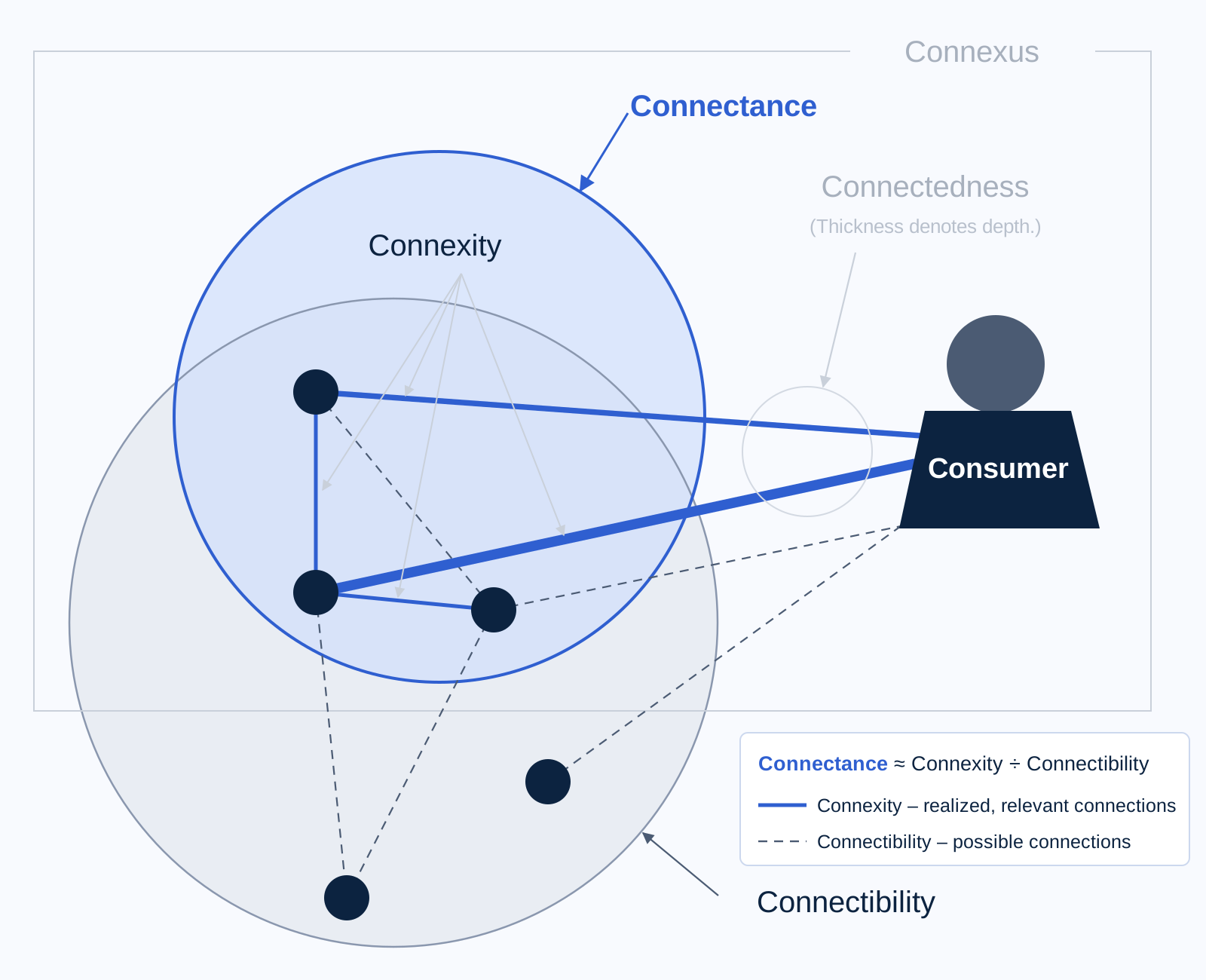
"Density of connections, conceptualized as the ratio of realized to possible links and the perceived saturation this creates." (Kim 2026)
In plain terms
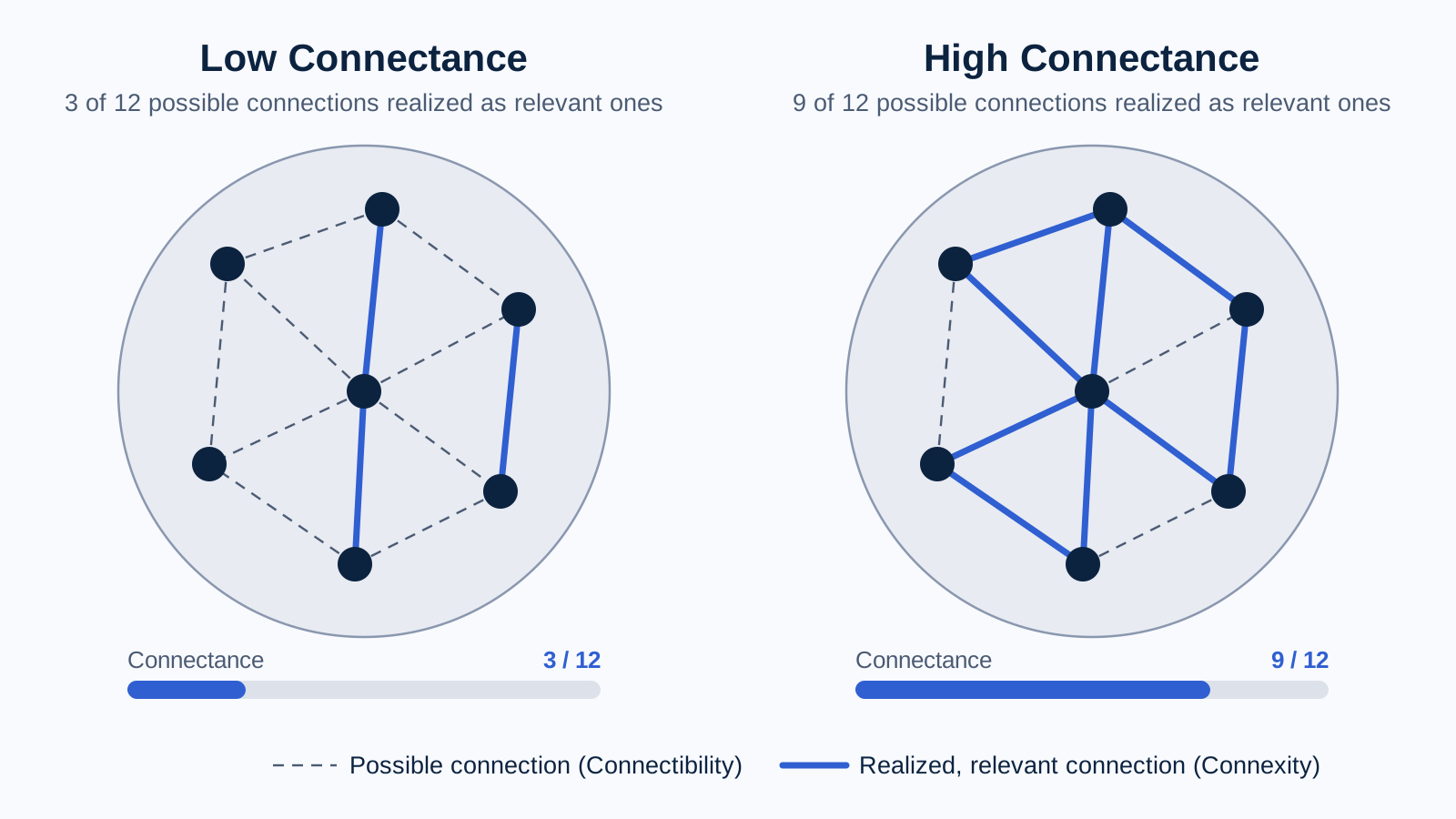
Connectance is the density of connections: how many of the possible connections are actually active and relevant, and how saturated the result feels to the people inside it. Structurally, it is the realized structure of connection; perceptually, it is how saturated that structure feels. Density is neither good nor bad in itself. It amplifies whatever moves through it. In network terms, it resembles utilization – useful redundancy at first, congestion once saturation exceeds capacity.
Why it matters
Dense, well-aligned connections reinforce meaning: consistent cues across channels build coherence, recognition, and recall. But the same density spreads disruption faster – a single misstep can reverberate through the whole network. And when similar messages pile up beyond people's attention, coherence turns into repetition, fatigue, or annoyance. The limit is not the number of links but what people can process.
Questions to ask
- If we added one more channel or touchpoint, what would it reinforce – and what would it crowd out?
- Where might people feel saturation rather than coherence?
- If something went wrong, how fast would it travel through our network?
How it connects
Connectance is built from the other Cs – it is the share of potential connections (Connectibility) that have become active and relevant (Connexity). Dense networks can also open new opportunities for connection, and together with Connectedness they shape how well the system performs (Connexus).
See it in practice
- More Connection Is Not Always Better
- Nike Doesn’t Have an Awareness Problem. It Has a Connection Problem.
- Understanding the World Through Connection
Source
Kim (2026), International Journal of Advertising. See the Research Foundation.